I still remember the first time someone replied to my text saying, “Both options are equivalent.”
I stared at the message for a moment, wondering if they meant “similar,” “equal,” or something more technical.
It wasn’t slang, but it felt like one of those words everyone understands except you in that moment.
If you’ve stumbled across “equivalent” in a chat, comment, or caption and felt the same confusion, you’re definitely not alone.
So let’s break it down in the simplest, clearest way possible.
Quick Answer:
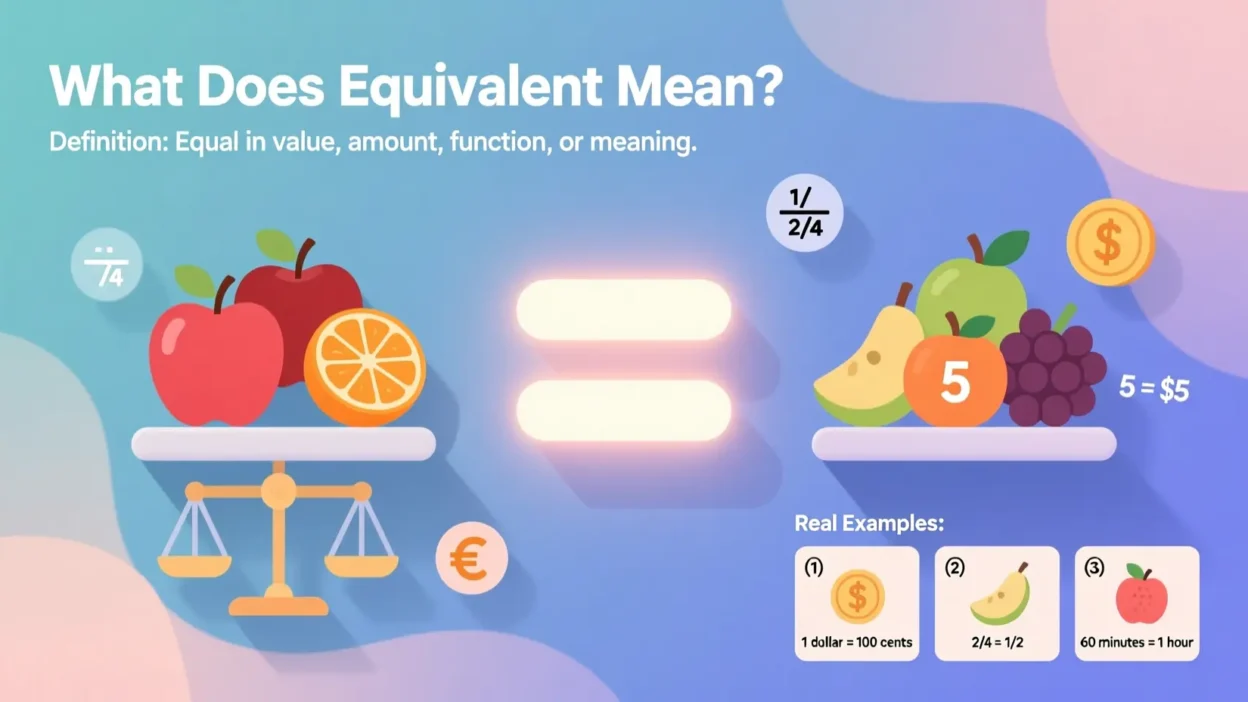
Equivalent means “equal in value, meaning, or effect.” It’s a smart, clear, neutral way of saying two things are basically the same or match in importance.
🧠 What Does Equivalent Mean in Text?
In texting or online conversations, “equivalent” is used to say that two things are equal, similar, or balanced in some way. It’s not a slang word — it’s an everyday English term often used for comparisons.
Example:
“Your offer is equivalent to what they proposed.”
In short: Equivalent = Equal / Same level / Same value.
📱 Where Is “Equivalent” Commonly Used?
You’ll mostly see equivalent in more thoughtful or detailed conversations — not in super casual slang chats.
Here’s where it often appears:
- 📚 Academic chats
- 👔 Work or professional messages
- 💬 WhatsApp / Messenger conversations
- 🌐 Online forums like Reddit or Quora
- 🧠 Discussions about choices, comparisons, or opinions
Tone:
- Not flirty
- Not slang
- Not overly formal
- Just clear, neutral, and smart-sounding
- Works in both casual and semi-formal contexts
💬 Examples of “Equivalent” in Conversation
Here are natural, short, realistic examples:
- A: can we swap shifts?
B: yeah, that works. both shifts are equivalent anyway. - A: is this the same as the old plan?
B: pretty much. the benefits are equivalent. - A: so my score is equivalent to yours?
B: yep, you both got 89. - A: are the prices similar?
B: almost equivalent, just a small difference. - A: is android equivalent to iphone?
B: depends what you need lol. - A: is 1 hour of walking equivalent to 30 mins of running?
B: kinda, depends on intensity haha. - A: the two options look the same?
B: yep, equivalent choices.
🕓 When to Use and When Not to Use “Equivalent”
✅ When to Use
- When comparing two things clearly
- When you want to sound clear and smart
- When explaining similarities
- When giving info in work/school chats
- When you want a neutral, non-emotional tone
❌ When NOT to Use
- Flirty or playful conversations
- Super casual slang messages
- When explaining urgent or emotional issues
- When simple words like “same” or “equal” fit better
- Very formal emails where a more specific phrase might be needed
Comparison Table
| Context | Example Phrase | Why It Works |
|---|---|---|
| Friend Chat | “both options are equivalent 😄” | Clear & casual |
| Work Chat | “these two reports are equivalent in value.” | Professional & precise |
| “The results appear equivalent across both groups.” | Formal & clear | |
| School/Assignment | “Your answer is equivalent to the original solution.” | Academic use |
| Online Debate | “Those statements aren’t equivalent.” | Analytical tone |
🔄 Similar Slang Words or Alternatives
| Word | Meaning | When to Use |
|---|---|---|
| Same | identical | Casual chats, quick replies |
| Equal | exactly the same in value or amount | Math, work, explanations |
| Similar | almost but not completely alike | General conversations |
| Equivalent to | equal in effect/value | Professional & detailed chats |
| Matches | lines up or corresponds | Reviews, comparisons |
| Comparable | close enough to be compared | Analytical or neutral tone |
❓ FAQs:
1. Is “equivalent” a slang word?
No. It’s a standard English word used in both casual and professional conversations.
2. Can “equivalent” be used in texting?
Yes — especially when you’re comparing two things clearly and want to sound precise.
3. Is “equivalent” the same as “equal”?
Almost. Equal means identical. Equivalent means equal in value or meaning, even if not identical.
4. Is “equivalent” formal?
It’s neutral. Works in everyday chats, work messages, and academic discussions.
5. What’s a simple word for “equivalent”?
“Same,” “equal,” or “similar.”
🔚 Conclusion:
The word “equivalent” is a simple yet powerful way to express that two things match in value, meaning, or effect.
Whether you’re texting a friend, explaining something at work, or comparing options online, it helps you communicate clearly and confidently.
It’s not slang — just a clean, neutral, smart-sounding word that fits almost anywhere.
Now that you know exactly how to use it, you’ll spot it everywhere and use it naturally in your own conversations.