You’ve probably seen “PO” written on a prescription label or heard a doctor say it quickly during a clinic visit — and maybe you thought, “Wait… PO as in post office?” Don’t worry, you’re not alone.
The first time many people see PO in a medical context, it feels like confusing code. It’s short, clinical, and looks nothing like everyday language.
But once you learn what it means, everything suddenly clicks.
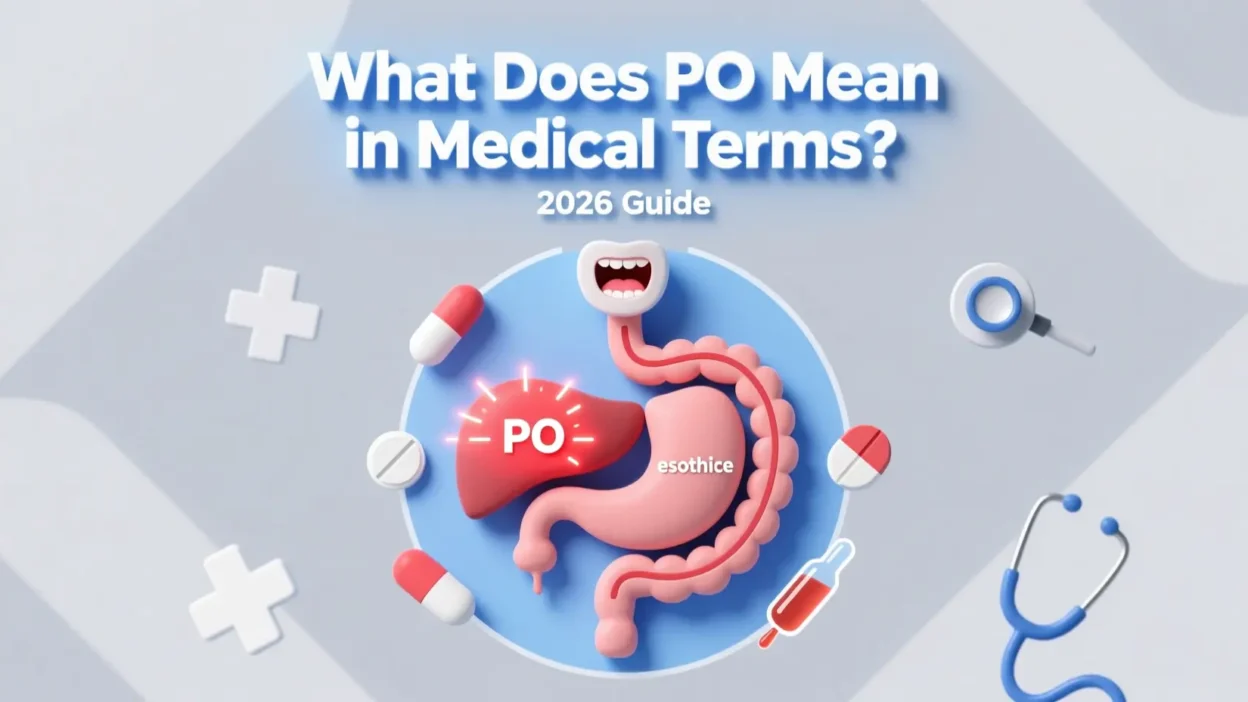
Quick Answer: PO means “by mouth” in medical terms. It’s a professional, clinical instruction used to tell patients to take medication orally.
🧠 What Does PO Mean in Text (Medical Terms)?
In medical settings, PO is an abbreviation of the Latin term “per os,” which translates to “by mouth.”
You’ll see it in prescriptions, hospital charts, discharge summaries, and medication labels.
It simply tells you that the medicine should be taken orally, not injected, inhaled, or applied on the skin.
Example:
“Take 1 tablet PO twice daily.”
Meaning → “Take 1 tablet by mouth two times a day.”
In short: PO = Per Os = Take by mouth.
📱 Where Is PO Commonly Used?
You’ll see PO mainly in medical and healthcare environments, such as:
- 🏥 Hospitals
- 💊 Pharmacy labels
- 🧾 Doctor’s prescriptions
- 🩺 Electronic medical records (EMR)
- 👩⚕️ Nurse notes and medication instructions
- 🚑 Emergency care charts
Tone:
- ✔️ Formal
- ✔️ Professional
- ❌ Not meant for casual texting or social media
💬 Examples of PO in Conversation
Here are realistic medical-style and patient-friendly examples:
1.
A: What did the doctor order for the pain?
B: Just Tylenol, 500 mg PO.
2.
A: How do I take this antibiotic?
B: You’ll take one capsule PO every 8 hours.
3.
A: Is this injection?
B: No, it’s PO — just swallow the tablet.
4.
A: Patient still vomiting — able to take PO meds?
B: Not yet, let’s hold them.
5.
A: Can I take this with food?
B: Yes, it’s fine. It’s PO medication.
6.
A: Is this liquid for drinking?
B: Yep, it’s PO formulation.
🕓 When to Use and When Not to Use PO
✅ When to Use “PO”
- When writing medical notes
- When giving professional medication instructions
- In pharmacy and nursing communication
- In clinical documentation or charts
- When describing oral medication routes
❌ When NOT to Use “PO”
- Casual texting
- Talking to someone unfamiliar with medical terms
- Formal patient communication where plain English is preferred
- Situations requiring clarity for safety
- Explaining directions to young children or non-English speakers
📊 Comparison Table
| Context | Example Phrase | Why It Works |
|---|---|---|
| Clinical Note | “Administer 1 tab PO BID.” | Standard medical shorthand |
| Nurse-to-Nurse Chat | “Is the PO med given?” | Quick professional communication |
| Patient-friendly explanation | “Please take this tablet by mouth.” | Clear and easy for non-medical people |
| Work email (non-medical) | “Take your medication by mouth as instructed.” | Polite & professional |
| Everyday conversation | “You take this orally.” | Normal conversational tone |
🔄 Similar Slang Words or Alternatives
| Term | Meaning | When to Use |
|---|---|---|
| IV | Intravenous (through a vein) | Hospital, emergency care |
| IM | Intramuscular (injected into muscle) | Vaccines, clinic injections |
| SL | Sublingual (under the tongue) | Fast-acting meds like nitroglycerin |
| PR | Per rectum | Certain suppositories, fever meds |
| Topical | Applied to skin | Creams, ointments, gels |
| PO PRN | By mouth as needed | Pain meds, allergy meds, etc. |
❓ FAQs:
1. Is PO the same as oral medication?
Yes — PO literally means “by mouth.”
2. Why do doctors use Latin abbreviations like PO?
Medical terminology historically comes from Latin and is still used for clarity and standardization worldwide.
3. Does PO refer to pills only?
No. It can refer to anything taken by mouth — tablets, capsules, liquids, suspensions, chewables, etc.
4. Is PO safe to use with patients?
Healthcare professionals should explain it in clear English:
“Take this by mouth.”
5. Can PO ever mean something else?
In medical terms, PO always refers to the oral route.